We will look at three technology disruptions that occurred one each in the 19th, 20th, and 21st centuries. This is technology broadly construed, not information technology alone. For each disruption, it happened relatively quickly, order of 10 years for the first one and sped up a little for the latter two. We will see what happened, what were their implications for the incumbents, the upstarts, and for society at large. And then we will see if any useful extrapolation is possible to today’s technology disruption of Generative AI. Spoiler alert: It is not, except for very limited aspects.
Canals to Railroads
The first disruption is the replacement of water transport on canals by trains on railroads. This happened roughly over the period of 1830 to 1850s. I recently “experienced” this through an evocative walk along the Wabash and Erie Canal at Delphi (Indiana). As I saw log cabins, trudged through a replica boat, and read of mules pulling boats through the relatively narrow and shallow canal, I felt the desolation of history, a once commercial mainstay having become an idle tourist’s ruminations of days gone by. Even that, there were no tourists either except for us, on an idyllic afternoon in the waning winter season.
The Canal connected the heart of the Midwest with the East Coast and in remarkably short span of time, made towns like Delphi prosperous. I read in the signage of the one-room schoolhouse how this prosperity allowed school children to have some semblance of text books, with the necessary pedagogical progression across grades. I read in the signage of the horse shoe shop how this prosperity triggered a healthy competition of shoe makers. And then, almost as suddenly, it was gone. The meandering pace of the boats pulled by mules, having to be changed every 10 miles, and with careful locks to lift boats up and down, became a thing of the past. This was replaced by the ruthless efficiency (for its time) of the railroad pulled by steam engines. Waterbodies like rivers still continued to be vital for trade as railroads could often not go there, but canals had been rendered obsolete.

In 1804, Richard Trevithick built the world’s first steam-powered locomotive, proving that high-pressure steam could move heavy loads on rails. Their speeds continued to rise rapidly and by the late 1850s rail became the dominant method of transport. So what happened to the companies that ran the canals and provided infrastructure around it? They did not fare too well. First, the canals had been built as public projects, with mechanisms like raising money through bonds. The public was left holding the bag when the canals went bust. Several of the cargo and passenger boating companies went bankrupt or were bought over by railroad companies in fire sales. Finally, in some cases the canals were sold to the rail companies so they could drain them and lay railroads.
So, in this case of technology disruption, it led to the vanishing of incumbents and crowning of new winners, which had not existed till a few years prior.
Horse-drawn carriages to cars
Horse-drawn carriages were the primary mode of transportation, both commercial and personal, for a really long time. In the US, they enjoyed this preeminent status from the late 17th century to the early part of the 20th century. In 1914 according to the US census, there were 5,000 companies in the business of manufacturing carriages and wagons, or repairing them. They formed the backbone of many cities and towns — having been to the Studebaker Museum in my backyard, South Bend, I had gotten a sense of the tremendous influence it had on the economy and the cultural zeitgeist of the town and the surrounding region.
When early automobiles arrived on the scene, first steam-powered, then electric (yes, electric vehicles predated gasoline-powered ones!), and then gasoline, they were laughable curiosities. They were loud and unreliable — you had to get out and crank them when they stalled, which they did ever so often — the poor dirt roads of the US were not kind to these automobiles, and gasp, there were no Shell gas stations at every block (or any other gas station for that matter). But they improved and became mass market remarkably quickly — most famously Ford’s Model T introduced in 1908 costing $850 (that’s $30,000 in today’s dollars, not much different from what we are used to now) went down to under $300 by the mid-1920s through the introduction of the moving assembly line in 1913. By 1920, the number of carriage and wagon manufacturers had dropped precipitously as automobiles became more practical — the number was fewer than 100 from the 5,000 just six years ago.
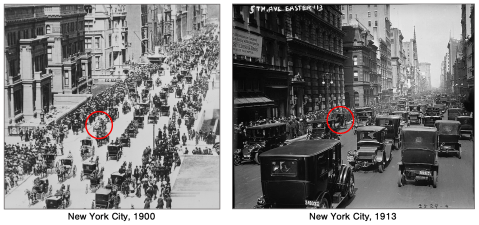
So how did the manufacturers of the old “technology” fare? The overwhelming majority vanished, with painful consequences for the local economies. Thanks to Amish culture, a few, very few could stay in their old business. A handful made the deft transition to making carriages for automobiles. And a single company made the transition to an automobile manufacturer, yes our storied Indiana company of Studebaker. It first started making electric vehicles and seeing the trend, quickly moved to gasoline-powered automobiles (and moved manufacturing from Detroit to South Bend). It survived till the 1950s, though it never recovered its prestige of being at the top of its industry.
Lesson learned is few, very few, of the incumbents see the impending storm and wait too long till the storm is here and get swept away to oblivion. What happened to the population as a result of the shift? Here we have a good news story though the causal factor is complex. The populations of three representative hotspots of horse carriage and buggy manufacturing increased from 1900 to 1930. The increase was largely due to the industrial age-driven boom and to a smaller extent, due to industries related to automobiles sprouting around these areas.
| City | 1900 population | 1930 population |
| South Bend, IN | 35,999 | 104,193 |
| Flint, MI | 13,103 | 156,492 |
| Cincinnati, OH | 325,902 | 451,160 |
Local computing infrastructure to cloud
Since the dawn of computing till the mid 2000s, if you wanted to do computing at any medium to large scale, you went out and bought all the equipment — computing nodes, racks to hold them, networking gear to connect them up, and enough power to power all of them and heating and cooling, the whole kit and caboodle. That meant you needed to have a good amount of cash at hand before you could offer any computing services. And then, an upstart company, one which had been selling books below market rate, and then the entire grocery store at below market rate, decided it would be a logical extension to sell computing services. So, it launched Amazon Web Services (AWS), followed shortly by Google App Engine (now Google Cloud Platform) and Microsoft Azure.
The premise was revolutionary for its time. You did not have to own a power plant and an electric transmission network to enjoy electricity at home. There was a “service provider”, the electric utility that provided that to you. Now copy that over to computing service. There were two big compelling arguments. First, you did not need to become computing experts; you could leave that to the experts at Amazon, Google, Microsoft, and the like. Second, the power of co-hosting multiple applications from multiple customers on the same computing equipment would drive up utilization and thus bring down costs.
This premise turned out to be a winning recipe. In its early years (2010-11), public cloud computing was a $50B market; today, it is a $1T worldwide market. Use of cloud computing at the largest enterprises, in all sectors, is near ubiquitous. For example, over 90% of Fortune 100 companies use AWS services. This uptake of cloud computing led to tremendous affluence at the normally low-margin Amazon and breathed life into a fast declining Microsoft. On the other side, the giants of the local computing era — HP, Dell, IBM — lost their position at the top of the pyramid. IBM tries desperately, and to this day, to act as the broker for organizations wanting to move applications to the cloud. The storied HP broke up into two and its revenues are a pale shadow of the non-cloud days. Dell chugs along beneath the radar but hardly at the center of any tech trend conversation. Efforts to remake oneself have largely been unsuccessful. IBM went through a variety of Platform-as-a-Service attempts (anyone remember Bluemix?), acquired companies to offer public cloud services (anyone remember Softlayer?), and stuttering Software-as-a-Service offerings. A case that sticks out is VMWare, the company that pioneered the concept of “virtual machines”, which underlies all of cloud computing. Belying conventional wisdom, it too fell on hard times as its technology became commoditized, and eventually got acquired by a giant, Broadcom, with little pretensions to leading the cloud sector.
Efforts at Extrapolation
So do these three “technology” disruptions of the 19th, 20th, and 21st centuries carry any lessons for the Generative AI disruption of today? There is no easily inferrable linear projection. The Generative AI blitzkrieg is far more widespread, its effect seeps into individual lives as well as corporate structures, and its tentacles are poised to wrap around a universal swath of industries (never before has the same tool been useful to a lawyer, a music lyricist, and a PhD student in our center). The broad lesson is that incumbents, gigantic behemoths, even virtual monopolies, get upended by upstarts. But for incumbents today, there is also a hopeful portent in the few exceptions that have bucked such blitzes.

