Context: India, the country of my birth, celebrates its Republic Day on January 26th. This was the day when India adopted the constitution, which occurred on January 26, 1950. India had achieved independence from Britain on August 15, 1947, but for its first three years the country remained governed by the colonial Government of India Act of 1935.
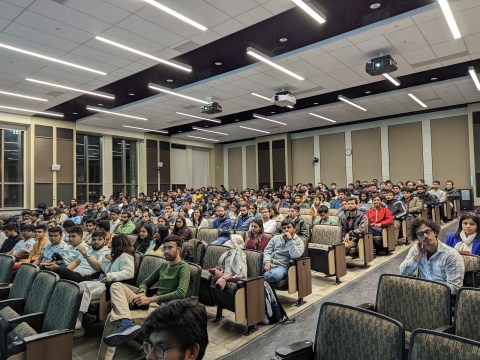
Republic Day was celebrated at Purdue by a set of India-related student organizations and I was asked to give some comments. Here are my prepared remarks given to a room of about 300 people, largely Indian students. I deviated from the script as I was not reading from it. I realize every time I speak on occasions like this that there is a fine line between jingoism (which puts off most) and idealistic fervor (which is appreciated by most).
We all know the history of Republic Day. We threw off colonialism, we created a constitution that began with the three words — “we the people”, incidentally the same three words as in the US Constitution. India remade itself from a primarily agrarian society into one that celebrates knowledge and innovation, into a high-tech hub of the global economy, into one that has the science and the technology might to leave its footprint on the moon.
India has made its progress in ways that do not make news. In 2004, around the time some of you were born, India’s poverty rate was almost 40%, with the poverty line being defined as below $2.15 per person per day. We can quibble with that World Bank definition, but consider this. Today that rate is 11%, a 4-fold improvement. That is progress indeed, made through many quiet steps.
Now big numbers like this are not very relatable. So what does it mean for you. Do you have a role to play in the making of India? And remember that India is always a story in making, it is never a finished product. This is exciting to many of you because you can have a say in that making, though you may feel that your voice is small and can get drowned out by loudmouths. For example, I am a part of the Asha for Education group here that funds basic education projects in India. When we raise money and fund one of our projects, say, Basundhara which is a residential school for orphaned/abandoned children in the outskirts of Cuttack, one may think pessimistically that what does it matter if we can benefit 100 children in that school. India has a dismal record for child welfare it ranks 115 out of 180 countries on well-being of children and 4% of the total child population in the age group 5-14 is used in child labor. But I can tell you from having visited several Asha projects, that for every single one of the children benefiting from our project, it matters a whole lot that they are in school and not in the fields or in a hazardous factory doing back breaking labor. Good deeds are often done not in big bangs but in small quiet voices.
Let us take a look at another angle to this. You are sitting here in West Lafayette and may feel somewhat disconnected from India. It is after all 8000 miles away and at times seems to be a million miles apart. But know that you represent India to the global community that is here at Purdue. When you present yourself, when you go out and get the award for a best project, when you get a patent and your home country is written as India, when you go out and win the Nobel Prize (winner Abhijeet Banerjee, 2018) or the Turing Award (only Indian-born winner, Raj Reddy, in 1994), or the Fields Medal (Indian-born winner in 2018) something a little smaller, like the best paper award at your premier conference, you are representing India. With the purchasing power of the US dollar relative to Indian rupee, what you spend in a visit to India goes a long way. And later on, when you are the founder of a startup company or the Director of a large multi-national company and employ people in India, you will be contributing in a big way.
So you have the opportunity to be a part of the history of India that is being written today and that will be written tomorrow. I exhort you to go out, live a life that you and your family can be proud of, and that India can be proud of.
 Distant Whispers from an Academic Engineer's World